Joyagoo Shipping Calculator: Turn Parcel Measurements into an Estimate
A Joyagoo shipping calculator needs the parcel's inputs, not only a list of product prices. Prepare the destination, contents, packed weight and outer dimensions. This page explains the calculation; it is not connected to a live carrier quote.
Start with consistent units
Measure the packed box in centimetres and record weight in kilograms when using the formula below. Product dimensions, an unboxed item and the parcel after protective packing can be different. Do not mix those measurements in one calculation.
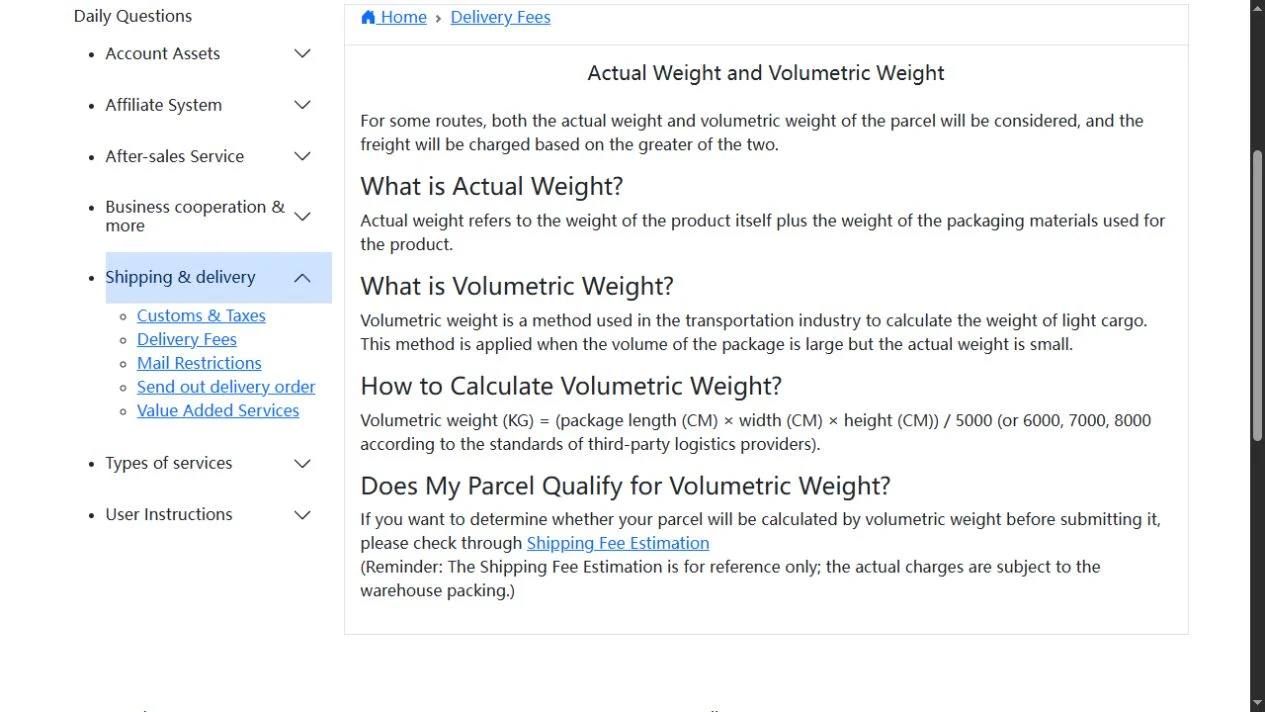
Joyagoo describes volumetric weight as length × width × height divided by the route's divisor. Its help page mentions different divisors according to the logistics provider, so confirm the actual line instead of assuming 6000 applies universally.
A worked example
The following inputs are illustrative, not a customer's shipment or a freight quote:
| Input | Example value |
|---|---|
| Packed dimensions | 45 × 32 × 25 cm |
| Actual weight | 4.1 kg |
| Assumed route divisor | 6000 |
| Volumetric weight | 45 × 32 × 25 / 6000 = 6 kg |
If this hypothetical route uses the greater of actual and volumetric weight, its starting weight basis is 6 kg. The monetary charge still needs the route's price, charging increments and applicable extras. Six kilograms is not itself a price.
Compare a different packing height
Using the same illustrative length and width with a height of 18 cm gives 45 × 32 × 18 / 6000 = 4.32 kg. The greater of 4.32 kg and 4.1 kg would be 4.32 kg before route-specific rounding. This shows why dimensions matter; it does not promise the warehouse can pack your contents into that box.
Keep necessary protection. Compare accessories with their shapes and openings in mind, and ask about actual packing before treating an assumed volume reduction as a saving.
Read the quote after the arithmetic
Compare what is included in the result and whether the route accepts the items. Splitting one parcel into two may reduce volume in one case but introduce separate minimum charges in another. Calculate both complete options instead of assuming either arrangement is always cheaper.
The shipping-cost guide covers these surrounding decisions. Use the buying guide if the items have not yet reached the QC and parcel stage.
Can I estimate before the goods arrive?
Yes, to plan a budget, but mark assumed weights and dimensions. Replace them with packed measurements when available.
Why can the final amount differ?
Packing, contents, route eligibility or charging conditions may change. Compare the inputs first when an estimate and later quote disagree.